Kevin Mahoney and I went to Cannon today. Things were looking interesting, but quite thin. Omega is forming (but not ready, unless you're insane) and Prozac might be approaching climbability (also for insane people). We did the Black Dike, which I hadn't done before. We didn't do a rock traverse; rather, we did a sometimes-formed direct start to the second pitch. After that, we rapped back down and did a variation to the second pitch called "Hassig's Direct." Instead of shooting off left into a rock traverse, you angle up right around some blocks to another ribbon of ice. Everything was super thin. There were some cool hook moves, but also a lot of dull pick-on-rock noises. I probably have to sharpen my picks again, and I just did them last night. We found some extremely sketchy rap anchors where people had evidently slung some blocks. Some of these were so solid, the blocks could be pulled out by hand! It looked like a little mousetrap for ice climbers. The approach/exit was quite slippery. I'm still recovering from some bronchitis I got a few weeks ago, so I'm not in stellar aerobic shape, but I trudged along anyways. Right now, I'd say it's some snow on ice-covered rocks, which is generally bad. There are a lot of fallen trees all over the trail. Apparently the people who made the trail got it wrong in a bunch of places, but our tracks have now corrected this. Of course, everything looks the same to me, especially in the winter. I'm not very good at that sort of thing.
No pictures yet...but Kevin will send them to me soon. In lieu of photos, some impressions: a pale sliver of a crescent moon at sunrise over the Notch; yellow, twisted ice in evil shapes strewn about wizened, leafless trees at the top of the Dike; and a patina of icy crust served on blocky Cannon granite.
Sunday, December 13, 2009


Wednesday, December 9, 2009
Sodium/Benzophenone
In preparation to make [6Li]HMDS, I had to distill N,N-dimethylethylamine from sodium/benzophenone overnight. Here's the cool color change:


Sunday, November 29, 2009
Campus Training
[edit: on an unrelated note, here is an interesting discussion about winter gloves]
I've been bouldering a lot inside recently and I knocked off a bunch of V5s this week. I feel like I've broken through a bit of a mental barrier. I used to think that I might, maybe, one day be able to do a V6. Now I can see that's going to happen reasonably soon, and in fact, harder stuff is possible. I wasn't a gymnast, wrestler, or other sort of inhuman superman as a child. In fact, I decided un-athletic as a child. I'm certainly not a natural at climbing--it's taken lots of concerted effort.
Well, one direction I direct my efforts towards is campus training. Invented by the redoubtable Wolfgang Gullich in 1988 for his famous route, Action Directe (5.14d here in America). Basically, there's a bunch of wooden rungs which you climb up with no feet. It's primarily a form of neuromuscular training which gives you both the macroscopic coordination you need to execute big, dynamic moves and the microscopic coordination you need (muscle fibers contracting simultaneously) to be able to "stick" deadpoints and dynos. It's said there's not much muscular conditioning, but I bet it increases your tendon and even bone strength. I read an interesting article in the New York Times that seemed to suggest that strength training is not as helpful for increasing bone density as has been previously imagined. In fact, bones need "large forces released in a relatively big burst" to get stronger. I wonder if campus training qualifies? Hmm.
Anyways, each of the rungs are numbered (#1-10). On the one at Metrorock, ten rungs are arranged four or five inches apart. There are three ladders with small, medium, and large rung thicknesses. When I started doing it (six months to a year ago), I could barely hang from the large rungs, let alone do any campus moves. I started by sticking a foot on and doing "lock-off touches" on the large rungs. Both hands start on rung #2, say. One hand remains on #2, while the other bumps from 2-3-4-5 and back again. I figured that if it was, in fact, neuromuscular conditioning, then full body weight was unnecessary. I don't know if I was right or not, but it worked. After a while I progressed to doing it with no feet on, and then to "laddering," which is where your hands alternate 2-3-4-5... and then back down. Now, just this week, I've progressed to skipping rungs 2-4-6... which is a lot harder, believe me. I can do the single step laddering on the medium rungs now too. Next up is the "double dyno" which means both hands start on rung X and then explode up to rung X+n (n=1 if you're me, but much more if you're crazy). Immediately, both hands drop back down to rung X. It's not as hard as it sounds--but I almost fell over with surprise when I did it for the first time.
Aside from being just plain fun on its own, I've noticed that campus training has helped my bouldering and to some extent, route climbing. I can make big dynamic moves. I'm actually excited, rather than terrified, of making big moves or climbing on very steep terrain. Everybody complains that campus training is "too harsh" or "too hard" or whatever, but I think it's great. As long as you gradually ease yourself into it, stop if it hurts, and do it maybe two weeks on/two weeks off, I think it's fine. I make sure I take 5-7 days off climbing every two months or so. You'd be surprised what a difference that makes. I don't have a problem with skin rubbing off or anything either. I make sure I wash my hands after every climbing session and moisturize with something greasy before I go to bed that night. That, and cutting off any calluses that form with nail clippers, keeps my hands relatively smooth and functional. Some people think that calluses actually help their climbing, but I think it actually gets in the way of making good contact. And, of course, if they get ripped off, then that really puts a damper on things.
Note: Everybody says this, but you probably shouldn't use the campus board unless you can boulder at least V4 because you can get hurt (it's hard on the tendons, joints, etc.).
I've been bouldering a lot inside recently and I knocked off a bunch of V5s this week. I feel like I've broken through a bit of a mental barrier. I used to think that I might, maybe, one day be able to do a V6. Now I can see that's going to happen reasonably soon, and in fact, harder stuff is possible. I wasn't a gymnast, wrestler, or other sort of inhuman superman as a child. In fact, I decided un-athletic as a child. I'm certainly not a natural at climbing--it's taken lots of concerted effort.
Well, one direction I direct my efforts towards is campus training. Invented by the redoubtable Wolfgang Gullich in 1988 for his famous route, Action Directe (5.14d here in America). Basically, there's a bunch of wooden rungs which you climb up with no feet. It's primarily a form of neuromuscular training which gives you both the macroscopic coordination you need to execute big, dynamic moves and the microscopic coordination you need (muscle fibers contracting simultaneously) to be able to "stick" deadpoints and dynos. It's said there's not much muscular conditioning, but I bet it increases your tendon and even bone strength. I read an interesting article in the New York Times that seemed to suggest that strength training is not as helpful for increasing bone density as has been previously imagined. In fact, bones need "large forces released in a relatively big burst" to get stronger. I wonder if campus training qualifies? Hmm.
Anyways, each of the rungs are numbered (#1-10). On the one at Metrorock, ten rungs are arranged four or five inches apart. There are three ladders with small, medium, and large rung thicknesses. When I started doing it (six months to a year ago), I could barely hang from the large rungs, let alone do any campus moves. I started by sticking a foot on and doing "lock-off touches" on the large rungs. Both hands start on rung #2, say. One hand remains on #2, while the other bumps from 2-3-4-5 and back again. I figured that if it was, in fact, neuromuscular conditioning, then full body weight was unnecessary. I don't know if I was right or not, but it worked. After a while I progressed to doing it with no feet on, and then to "laddering," which is where your hands alternate 2-3-4-5... and then back down. Now, just this week, I've progressed to skipping rungs 2-4-6... which is a lot harder, believe me. I can do the single step laddering on the medium rungs now too. Next up is the "double dyno" which means both hands start on rung X and then explode up to rung X+n (n=1 if you're me, but much more if you're crazy). Immediately, both hands drop back down to rung X. It's not as hard as it sounds--but I almost fell over with surprise when I did it for the first time.
Aside from being just plain fun on its own, I've noticed that campus training has helped my bouldering and to some extent, route climbing. I can make big dynamic moves. I'm actually excited, rather than terrified, of making big moves or climbing on very steep terrain. Everybody complains that campus training is "too harsh" or "too hard" or whatever, but I think it's great. As long as you gradually ease yourself into it, stop if it hurts, and do it maybe two weeks on/two weeks off, I think it's fine. I make sure I take 5-7 days off climbing every two months or so. You'd be surprised what a difference that makes. I don't have a problem with skin rubbing off or anything either. I make sure I wash my hands after every climbing session and moisturize with something greasy before I go to bed that night. That, and cutting off any calluses that form with nail clippers, keeps my hands relatively smooth and functional. Some people think that calluses actually help their climbing, but I think it actually gets in the way of making good contact. And, of course, if they get ripped off, then that really puts a damper on things.
Note: Everybody says this, but you probably shouldn't use the campus board unless you can boulder at least V4 because you can get hurt (it's hard on the tendons, joints, etc.).
Sunday, November 22, 2009
Crow Hill, Headpointing
Jonathan and I went to do some practice aid today at Crow Hill. I led Intertwine and he jugged it:
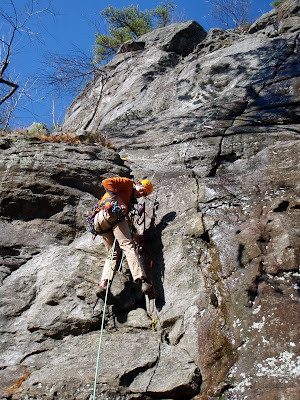
It was sunny, beautiful, and wet. Then Jonathan did his first aid lead on Jane, which I'll call C2. I've decided I'm going to try to headpoint it, so I worked it on top-rope, figuring out gear placements and beta.
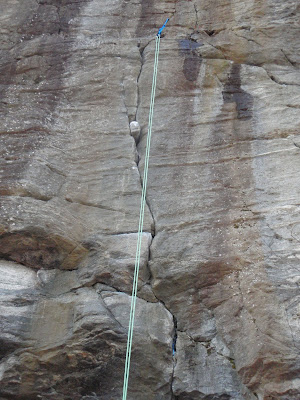 I've one hung it so far. I'm close, but the back of my hand hurts from jamming now, so I'll have to come back to it. It's supposedly easy 11, but it's hard for me--I'm not used to crack climbing. There's real jams and stuff on it.
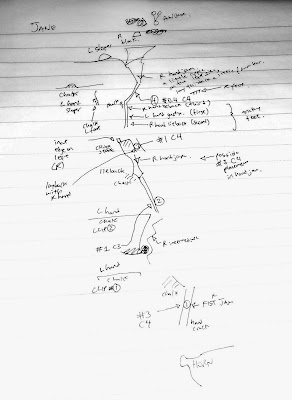 I made a beta sheet for it, 'cause I think I might not get back to it for a while. I'm super psyched about it though.

It was sunny, beautiful, and wet. Then Jonathan did his first aid lead on Jane, which I'll call C2. I've decided I'm going to try to headpoint it, so I worked it on top-rope, figuring out gear placements and beta.
 I've one hung it so far. I'm close, but the back of my hand hurts from jamming now, so I'll have to come back to it. It's supposedly easy 11, but it's hard for me--I'm not used to crack climbing. There's real jams and stuff on it.
 I made a beta sheet for it, 'cause I think I might not get back to it for a while. I'm super psyched about it though.
Wednesday, November 11, 2009
Rufus

Rumney on Sunday was beautiful. The climbing was overtaken by a chocolate lab puppy named Rufus. Depending on who you believe, Rufus (a) is as much Rachel's puppy as it is Vanessa and Mike's; (b) might have Down's syndrome; or (c) is much more interested in unsuccessfully gnawing at over-sized plastic bottles than you. He's also very interested in midday naps, as shown above.
Sunday, November 1, 2009
Mordor Wall
I went back to tackle the Mordor Wall again with Dunbar yesterday. It went all right, but not perfectly. We ended up doing the first three pitches and then bailing. We weren't moving particularly quickly, I was spooked by a slopey bat hook, a sketchy top-step, and a lot of running water, and time was running out. The sketchy top-step occurred because of the slopey bat hook, in fact. I'd set my talon, "ooze" onto the placement, and shriek when it fell out. Dunbar, on the other hand, led the second pitch, a bolted bat hook traverse, and seemed quite nonchalant. He's calmer than I am on stuff like this. I need time to get into a comfort zone; he seems at home. It's admirable. Anyways, more talking would only bore you, so here are a bunch of pictures:
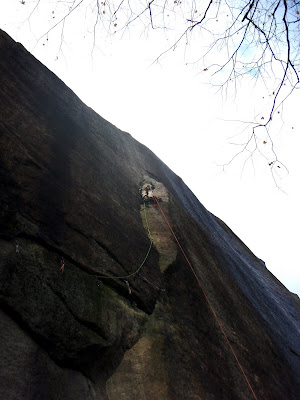 Me leading the first pitch.
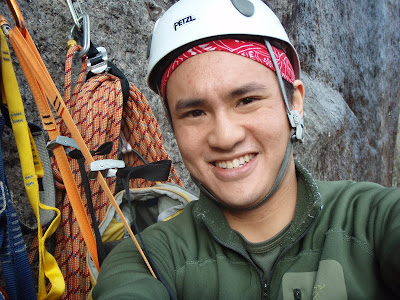 At a belay. There's a lot of stuff.
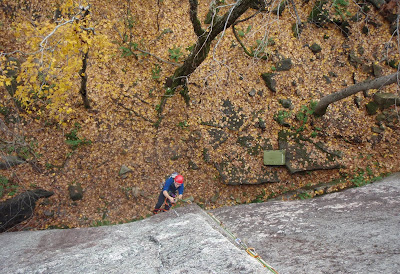 Dunbar jugging on a beautiful fall day.
 Dunbar leading on the bat hook traverse.
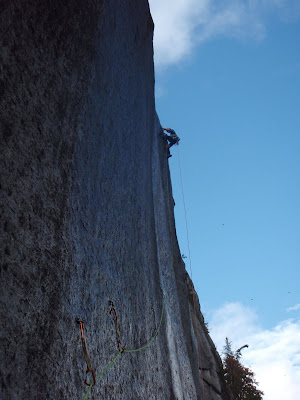 Dunbar climbing out of Mordor.
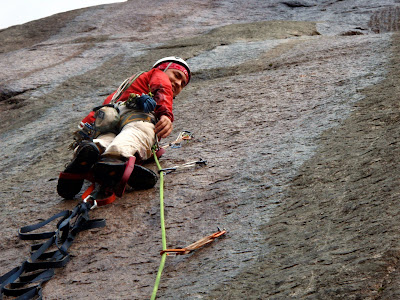 Am I hooking a bolt with a grappling hook? Um, yes.
 Dunbar looking like a stoic Russian general here. He's
usually more jovial than this, but you can't tell from this
picture!
 Rack for the day: doubles in the C3s, double C4s up to 2",
double BD stoppers and micro nuts, 18 draws, a bunch of
hooks, etc. Can you identify everything in the picture?
 Me leading the first pitch.
 At a belay. There's a lot of stuff.
 Dunbar jugging on a beautiful fall day.
 Dunbar leading on the bat hook traverse.
 Dunbar climbing out of Mordor.
 Am I hooking a bolt with a grappling hook? Um, yes.
 Dunbar looking like a stoic Russian general here. He's
usually more jovial than this, but you can't tell from this
picture!
 Rack for the day: doubles in the C3s, double C4s up to 2",
double BD stoppers and micro nuts, 18 draws, a bunch of
hooks, etc. Can you identify everything in the picture?
Monday, October 26, 2009
Ice Screw Sharpening
Despite the fact that many of us experienced a warm, comfortable day
yesterday at Rumney, I have to admit I feel the ice clasp of winter
approaching. Fortunately, I also feel feverish excitement for the
upcoming ice season. In the last few years, my ice rack has seen some
use, and I've been trying to figure out how to sharpen my screws.
Last year, I found somebody who would sharpen screws via mail, but as he
went out of business, I'm on my own now. There are other people who claim
to sharpen ice screws out there, but with all the mumblings I've heard
about bad results and machine sharpening, I don't trust them. Like most
people, I have an all Black Diamond rack of Turbo Express ice screws (some
of the older ones, some of the newer ones). According to BD (personal
communication), each screw is machine cut, and then hand sharpened. They
recommend against the use of machine sharpeners or grinders because the
heat generated can damage the temper of the steel.
BD gives some instructions for how to sharpen them on your own:
http://www.blackdiamondequipment.com/en-us/customer-service/faqs#climb
I tried it this afternoon and my impression is as follows. Any bozo, such
as myself, can sharpen screws to a mediocre level. It's easy to remove
any offending burrs, rust spots, or dull edges. However, it's very tricky
to get the screws back to their original geometry. If one carefully
inspects a brand new screw, it's obvious that there are subtle little
contours which end in a relatively sharply pointed tooth. These contours
were very difficult to replicate in my inexperienced hands. My sharpened
screws are still relatively sharp, but the teeth are not as agressive as
before. Still, according to BD, such screws will work much better than
their unsharpened counterparts.
In any case, I think there's a limited amount of sharpening a screw will
take before further sharpening will start biting into the threads. In the
future, I just plan to be very careful about not damaging the teeth of my
screws. The other thing is that screws are prone to rust damage, so
drying them out promptly after climbing is important, as is lubricating
their insides. I've settled on two quick shots of WD40, once from the top
and once from the bottom. I think this not only facilitates ice removal,
but also repels water and rust. I don't think the WD40 is very good for
the rest of my climbing gear, so I flicked and wiped the screws dry as
best I could afterwards. Too much oil probably means the screws will
start accumulating all sorts of dirt.
yesterday at Rumney, I have to admit I feel the ice clasp of winter
approaching. Fortunately, I also feel feverish excitement for the
upcoming ice season. In the last few years, my ice rack has seen some
use, and I've been trying to figure out how to sharpen my screws.
Last year, I found somebody who would sharpen screws via mail, but as he
went out of business, I'm on my own now. There are other people who claim
to sharpen ice screws out there, but with all the mumblings I've heard
about bad results and machine sharpening, I don't trust them. Like most
people, I have an all Black Diamond rack of Turbo Express ice screws (some
of the older ones, some of the newer ones). According to BD (personal
communication), each screw is machine cut, and then hand sharpened. They
recommend against the use of machine sharpeners or grinders because the
heat generated can damage the temper of the steel.
BD gives some instructions for how to sharpen them on your own:
http://www.blackdiamondequipment.com/en-us/customer-service/faqs#climb
I tried it this afternoon and my impression is as follows. Any bozo, such
as myself, can sharpen screws to a mediocre level. It's easy to remove
any offending burrs, rust spots, or dull edges. However, it's very tricky
to get the screws back to their original geometry. If one carefully
inspects a brand new screw, it's obvious that there are subtle little
contours which end in a relatively sharply pointed tooth. These contours
were very difficult to replicate in my inexperienced hands. My sharpened
screws are still relatively sharp, but the teeth are not as agressive as
before. Still, according to BD, such screws will work much better than
their unsharpened counterparts.
In any case, I think there's a limited amount of sharpening a screw will
take before further sharpening will start biting into the threads. In the
future, I just plan to be very careful about not damaging the teeth of my
screws. The other thing is that screws are prone to rust damage, so
drying them out promptly after climbing is important, as is lubricating
their insides. I've settled on two quick shots of WD40, once from the top
and once from the bottom. I think this not only facilitates ice removal,
but also repels water and rust. I don't think the WD40 is very good for
the rest of my climbing gear, so I flicked and wiped the screws dry as
best I could afterwards. Too much oil probably means the screws will
start accumulating all sorts of dirt.
Subscribe to:
Posts (Atom)